Address
30 N Gould St.
Suite R, Sheridan, WY 82801, USA

GHRP-2 vs GHRP-6: Key Differences in Growth Hormone Research, Appetite Pathways, and Peptide Study Use

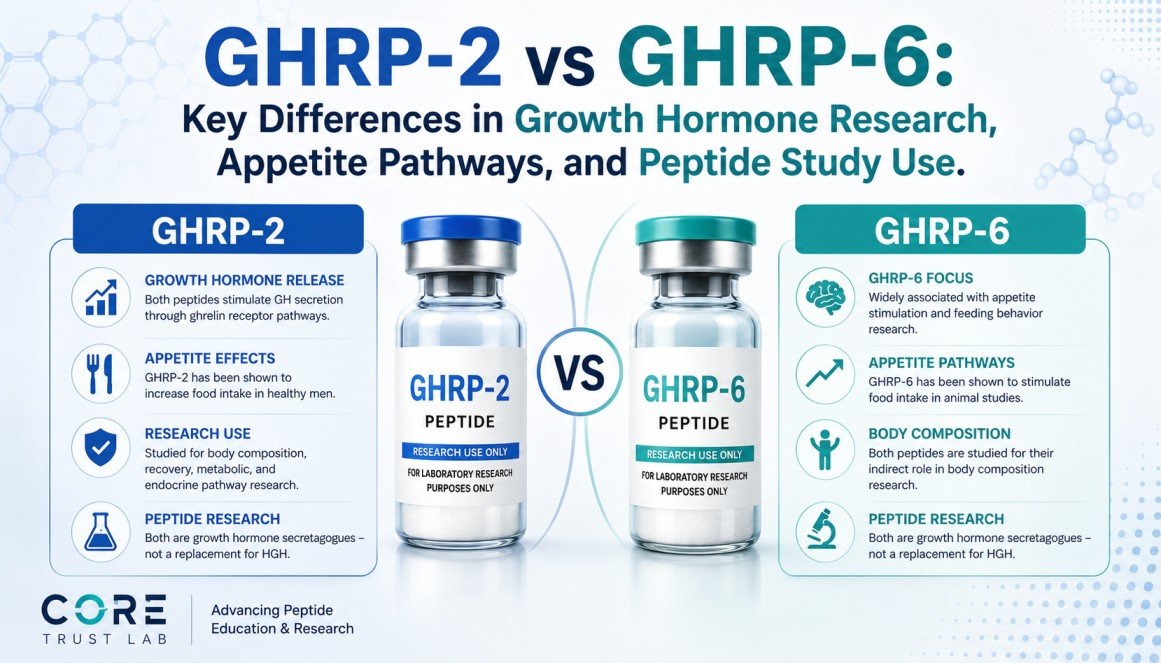
GHRP-2 and GHRP-6 are two growth hormone-releasing peptides often discussed in peptide research, body-composition studies, recovery-related research, and growth hormone pathway education. Because their names are similar, many readers assume they work exactly the same way. However, while they belong to the same broader peptide category, they are not identical.
Both GHRP-2 and GHRP-6 are synthetic growth hormone secretagogues. This means they are studied for their ability to stimulate growth hormone release through pathways connected with the growth hormone secretagogue receptor and ghrelin-related signaling. Research on GHRP-2 describes it as a synthetic agonist of ghrelin, which binds to the growth hormone secretagogue receptor and is associated with growth hormone release and appetite-related effects.
GHRP-6 is also widely discussed as a growth hormone-releasing peptide and has been studied for its relationship with GH release and appetite pathways. Research in animal models has shown that central administration of GHRP-6 can stimulate food intake and activate appetite-related brain pathways.
This guide explains the key differences between GHRP-2 and GHRP-6, including mechanism, appetite effects, growth hormone pathway research, body-composition relevance, safety considerations, and how these peptides fit into broader research-use discussions.
Quick Answer: GHRP-2 vs GHRP-6
GHRP-2 and GHRP-6 are both synthetic growth hormone-releasing peptides, but they are commonly discussed with slightly different research emphasis.
GHRP-2 is often described as a potent growth hormone secretagogue that may be associated with appetite effects through ghrelin-related pathways. Human research has reported that GHRP-2, like ghrelin, can increase food intake in healthy men.
GHRP-6 is also studied as a growth hormone-releasing peptide and is especially known in research discussions for its connection with appetite stimulation and feeding behavior. Studies have reported that GHRP-6 can stimulate food intake in animal models.
In simple terms:
- GHRP-2 and GHRP-6 both belong to the growth hormone secretagogue peptide category.
- Both are studied in relation to growth hormone release.
- Both interact with ghrelin-related pathways.
- GHRP-6 is often more strongly associated with appetite stimulation in peptide discussions.
- GHRP-2 is often discussed as a strong GH-releasing peptide with appetite-related effects also reported in research.
- Neither peptide should be confused with direct human growth hormone replacement.
Readers who want to understand related growth hormone pathway peptides may also find What Is Ipamorelin Peptide? Benefits, Fat Loss Potential, and How It Works helpful.
Comparison Table: GHRP-2 vs GHRP-6
| Feature | GHRP-2 | GHRP-6 |
|---|---|---|
| Peptide Category | Growth hormone-releasing peptide | Growth hormone-releasing peptide |
| Main Research Focus | GH release and ghrelin-related signaling | GH release and appetite-related pathways |
| Growth Hormone Pathway | Yes | Yes |
| Ghrelin Receptor Connection | Yes | Yes |
| Appetite Research | Reported in human research | Strongly discussed in feeding-behavior research |
| Direct HGH Replacement | No | No |
| Body-Composition Research | Indirect pathway via GH-related studies | Indirect pathway via GH and appetite-related studies |
| Research Positioning | Growth hormone secretagogue research | Growth hormone secretagogue and appetite pathway research |
This table helps clarify that GHRP-2 and GHRP-6 are closely related but not identical. They are best understood as two separate peptides within the growth hormone secretagogue research category.
What Is GHRP-2?
GHRP-2 stands for Growth Hormone-Releasing Peptide-2. It is a synthetic peptide studied for its ability to stimulate growth hormone release.
GHRP-2 is commonly discussed as a ghrelin receptor agonist. Ghrelin is a naturally occurring hormone involved in hunger signaling, growth hormone release, and energy balance. Because GHRP-2 interacts with ghrelin-related pathways, researchers have studied its effects not only on GH secretion but also on food intake and appetite behavior.
In human research, GHRP-2 has been reported to increase food intake in healthy men, showing that its effects can extend beyond growth hormone release alone.
In research discussions, GHRP-2 is commonly associated with:
- Growth hormone secretion
- Ghrelin receptor signaling
- Appetite-related pathways
- Body-composition research
- Recovery-related research
- Metabolic signaling studies
However, it should not be described as a guaranteed performance, fat-loss, or recovery solution. It is more accurate to discuss GHRP-2 as a research peptide studied in relation to growth hormone and ghrelin-related pathways.
What Is GHRP-6?
GHRP-6 stands for Growth Hormone-Releasing Peptide-6. Like GHRP-2, it is a synthetic growth hormone secretagogue studied for its ability to stimulate GH release.
GHRP-6 is one of the better-known peptides in the GHRP category because of its long history in growth hormone secretagogue research. It is frequently discussed in relation to appetite pathways because of its connection with ghrelin-like signaling.
Research has shown that GHRP-6 may stimulate feeding behavior in animal models. One study reported that central administration of ghrelin or GHRP-6 significantly stimulated food intake in rats, and the effect involved appetite-related signaling pathways.
In research discussions, GHRP-6 is commonly associated with:
- Growth hormone release
- Ghrelin-related signaling
- Appetite stimulation research
- Feeding behavior studies
- Metabolic pathway research
- Body-composition discussions
Like GHRP-2, GHRP-6 should be discussed carefully as a research peptide. It should not be presented as a simple or guaranteed body-composition tool.
How Do GHRP-2 and GHRP-6 Work?
GHRP-2 and GHRP-6 are studied through pathways related to the growth hormone secretagogue receptor. This receptor is closely connected with ghrelin biology.
Ghrelin is often called the “hunger hormone,” but that phrase is too simple. Ghrelin is involved in several biological processes, including appetite regulation, energy balance, growth hormone release, and metabolic signaling.
GHRP-2 and GHRP-6 are studied because they may interact with these systems and stimulate growth hormone release from the pituitary gland.
Growth Hormone Secretagogue Pathway
Growth hormone secretagogues do not supply growth hormone directly. Instead, they are studied for their ability to signal the body’s existing endocrine system to release growth hormone.
This is different from direct HGH administration.
The general research concept is:
- The peptide interacts with growth hormone secretagogue pathways.
- The pituitary gland may respond by releasing growth hormone.
- Growth hormone may then influence downstream pathways related to metabolism, recovery, and body composition.
This does not mean the outcome is automatic or identical in every setting. Growth hormone biology is complex and influenced by many factors, including age, sleep, nutrition, endocrine status, and study design.
Ghrelin-Related Pathways
Both GHRP-2 and GHRP-6 are connected with ghrelin-related signaling. This is one reason appetite appears frequently in research discussions about these peptides.
Human research has reported that GHRP-2 can increase food intake, while animal research has reported feeding effects with GHRP-6.
This appetite connection is important because it separates GHRP peptides from some other peptide categories. For example, AOD-9604 vs Semaglutide: Key Differences in Mechanism, Evidence, and Research Use compares peptides and GLP-1 compounds that work through completely different mechanisms.
GHRP-2 vs GHRP-6 for Growth Hormone Research
Both GHRP-2 and GHRP-6 are studied for their ability to stimulate growth hormone release.
The main difference is not that one belongs to a completely different category. Instead, the difference is in how each peptide is discussed across research settings, especially regarding potency, appetite response, and peptide selection in experimental designs.
GHRP-2 is often discussed as a strong GH-releasing peptide. GHRP-6 is also a GH-releasing peptide, but it is especially known for its appetite-related research profile.
In simplified research terms:
- GHRP-2 is often emphasized for GH secretagogue activity.
- GHRP-6 is often emphasized for GH release plus appetite pathway research.
- Both may interact with ghrelin-related pathways.
- Both require careful interpretation because growth hormone response can vary.
Readers comparing growth hormone pathway peptides may also want to read Best Time to Take Ipamorelin: Research Timing, Benefits, and Practical Considerations, which discusses a different GH-related peptide often compared with GHRPs.
GHRP-2 vs GHRP-6 for Appetite Research
Appetite is one of the biggest reasons people compare GHRP-2 and GHRP-6.
GHRP-6 is often more strongly associated with appetite stimulation in peptide discussions. Its connection with feeding behavior has been studied in animal models, where GHRP-6 was shown to stimulate food intake.
GHRP-2 is also associated with appetite effects. Human research has reported that GHRP-2 increased food intake in healthy men, and another study examined its stimulatory effect on food intake in obese subjects.
This means it would be inaccurate to say that only GHRP-6 affects appetite. A better explanation is that both peptides are connected with appetite-related pathways, but GHRP-6 is often discussed more prominently for this effect in peptide education.
Why Appetite Matters in Research
Appetite effects can influence how a compound is evaluated in body-composition research.
For example, if a peptide increases food intake, that may affect:
- Caloric intake
- Weight-change interpretation
- Body-composition outcomes
- Study design
- Participant behavior
- Metabolic measurements
This is why appetite should not be treated as a side note. It is central to understanding GHRP-related research.
GHRP-2 vs GHRP-6 for Body-Composition Research
GHRP-2 and GHRP-6 are sometimes discussed in body-composition research because of their relationship with growth hormone pathways. Growth hormone is involved in metabolism, tissue maintenance, and body-composition-related biology.
However, it is important not to overstate this relationship.
A peptide that stimulates GH release in a research setting does not automatically produce predictable fat-loss, muscle-gain, or performance outcomes. Body composition is influenced by many factors, including:
- Nutrition
- Sleep
- Exercise
- Hormonal status
- Age
- Metabolic health
- Recovery capacity
- Total energy intake
This is especially important when discussing GHRP-6 because appetite stimulation may affect caloric intake. If food intake increases, body-composition outcomes may differ depending on the context of the study.
For readers comparing peptide approaches to body composition, Ipamorelin vs Semaglutide: Key Differences in Fat Loss and Body Composition provides helpful context.
GHRP-2 vs GHRP-6 vs Ipamorelin
GHRP-2, GHRP-6, and Ipamorelin are often compared because all three are discussed in relation to growth hormone secretagogue research.
However, Ipamorelin is often positioned differently because it is commonly described as a more selective growth hormone secretagogue in peptide education. It is frequently discussed in relation to GH release with less emphasis on appetite stimulation compared with older GHRPs.
That said, comparisons should be made carefully. Each peptide has its own research history, receptor activity profile, and evidence limitations.
GHRP-2
GHRP-2 is commonly studied for:
- GH secretion
- Ghrelin receptor signaling
- Appetite-related pathways
- Metabolic research
GHRP-6
GHRP-6 is commonly studied for:
- GH secretion
- Appetite stimulation research
- Feeding behavior
- Ghrelin-related pathways
Ipamorelin
Ipamorelin is commonly discussed in relation to:
- GH secretagogue research
- Recovery-related peptide education
- Body-composition research
- Timing and consistency in peptide study routines
For more details, read What Is Ipamorelin Peptide? Benefits, Fat Loss Potential, and How It Works.
Research Use: Where GHRP-2 Fits
GHRP-2 is best understood as a research peptide studied in relation to growth hormone release and ghrelin-related pathways.
It may be relevant in studies examining:
- GH secretion
- Appetite signaling
- Endocrine response
- Metabolic pathways
- Body-composition mechanisms
- Recovery-related biology
Because GHRP-2 is connected with both GH and appetite pathways, researchers should interpret findings carefully. Appetite changes can influence metabolic outcomes and study results.
Research Use: Where GHRP-6 Fits
GHRP-6 is best understood as a growth hormone-releasing peptide with strong relevance to appetite and feeding-behavior research.
It may be relevant in studies examining:
- GH release
- Ghrelin receptor signaling
- Feeding behavior
- Appetite stimulation
- Energy intake
- Metabolic research
- Body-composition interpretation
GHRP-6 should not be simplified as only a growth hormone peptide. Its appetite pathway relevance is one of the main reasons it is often discussed separately from other GH secretagogues.
Safety Considerations
GHRP-2 and GHRP-6 should be discussed with caution because they influence endocrine and appetite-related pathways.
Research-use discussions should avoid claims that make these peptides sound risk-free or guaranteed to produce predictable outcomes.
Potential research considerations include:
- Hormonal response variability
- Appetite-related effects
- Individual metabolic differences
- Study design limitations
- Route of administration
- Product quality
- Purity and handling
- Long-term evidence gaps
Growth hormone pathway research can be complex. Effects may vary depending on dose, timing, frequency, age, health status, and other biological variables.
A careful and responsible explanation should focus on mechanism, evidence, limitations, and study context rather than exaggerated claims.
Common Misconceptions About GHRP-2 and GHRP-6
Misconception 1: GHRP-2 and GHRP-6 Are the Same
They are related, but not identical. Both belong to the growth hormone-releasing peptide category, but they are often discussed with different emphasis, especially around appetite response.
Misconception 2: GHRP-6 Is the Only GHRP That Affects Appetite
GHRP-6 is strongly associated with appetite stimulation, but GHRP-2 has also been reported to increase food intake in human research.
Misconception 3: GHRPs Are the Same as HGH
GHRPs are not direct HGH. They are studied for their ability to stimulate growth hormone release through the body’s own signaling systems.
Misconception 4: More GH Release Always Means Better Results
This is too simplistic. Growth hormone biology is complex, and outcomes depend on many factors, including nutrition, sleep, metabolic status, endocrine balance, and study context.
Misconception 5: GHRPs Guarantee Fat Loss or Muscle Gain
GHRP-2 and GHRP-6 should not be described as guaranteed fat-loss or muscle-building compounds. They are better discussed as research peptides studied in relation to GH and metabolic pathways.
Frequently Asked Questions
What is the main difference between GHRP-2 and GHRP-6?
GHRP-2 and GHRP-6 are both growth hormone-releasing peptides, but GHRP-6 is often more strongly associated with appetite-stimulation research, while GHRP-2 is often discussed as a potent GH secretagogue with appetite effects also reported.
Is GHRP-2 stronger than GHRP-6?
The answer depends on the research context and outcome being measured. Both peptides are studied for growth hormone release, but their appetite-related profiles and experimental uses may differ.
Does GHRP-6 increase appetite?
GHRP-6 is commonly associated with appetite stimulation. Research in animal models has shown that GHRP-6 can stimulate food intake.
Does GHRP-2 increase appetite?
GHRP-2 may also influence appetite. Human research has reported that GHRP-2 increased food intake in healthy men and has been studied for food-intake effects in obese subjects.
Are GHRP-2 and GHRP-6 peptides?
Yes. Both GHRP-2 and GHRP-6 are synthetic peptides studied in relation to growth hormone release.
Are GHRP-2 and GHRP-6 the same as Ipamorelin?
No. GHRP-2, GHRP-6, and Ipamorelin are all discussed in growth hormone secretagogue research, but they are separate peptides with different research profiles.
Are GHRP-2 and GHRP-6 the same as HGH?
No. GHRP-2 and GHRP-6 are not human growth hormone. They are growth hormone secretagogues studied for their ability to stimulate GH release.
Which peptide is more associated with appetite research?
GHRP-6 is often more strongly associated with appetite stimulation in peptide discussions, although GHRP-2 has also been shown to influence food intake in human research.
Final Thoughts: GHRP-2 vs GHRP-6
GHRP-2 and GHRP-6 are closely related growth hormone-releasing peptides, but they should not be treated as identical.
Both are studied in relation to growth hormone release, ghrelin-related signaling, and metabolic research. GHRP-6 is especially known for its connection with appetite and feeding-behavior research, while GHRP-2 is often discussed as a strong growth hormone secretagogue with appetite effects also observed in human studies.
The most important takeaway is that both peptides belong to the growth hormone secretagogue category, but their research profiles differ in meaningful ways.
GHRP-2 and GHRP-6 should be discussed carefully, especially when interpreting body-composition, appetite, or recovery-related claims. A responsible understanding focuses on mechanism, evidence, limitations, and research context rather than exaggerated outcomes.
For readers exploring related peptide topics, What Is Ipamorelin Peptide? , What Is NAD+? and Best Time to Take Ipamorelin are useful next reads.