Address
30 N Gould St.
Suite R, Sheridan, WY 82801, USA

AOD-9604 vs Semaglutide: Mechanism, Evidence & Research Use

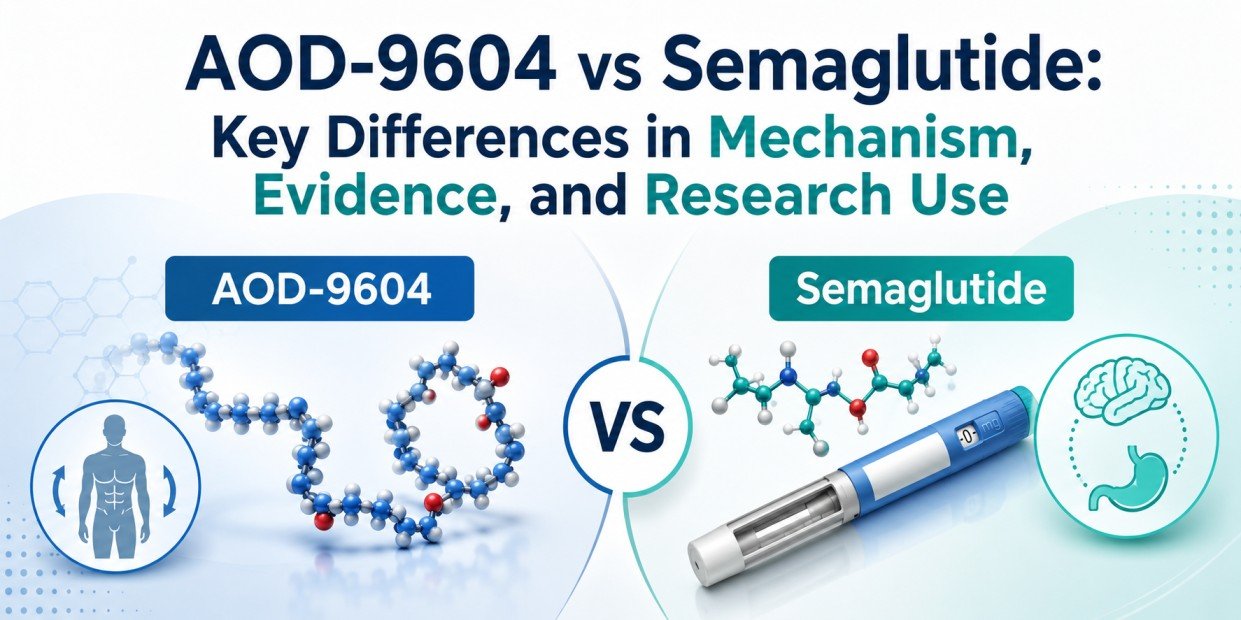
AOD-9604 and Semaglutide are often discussed in the same conversation because both are connected with body-composition and metabolic research. However, they are very different compounds with different mechanisms, different evidence levels, and different research purposes.
Semaglutide is a GLP-1 receptor agonist. It works by activating GLP-1 receptors, which are involved in appetite regulation, insulin secretion, glucagon reduction, gastric emptying, and blood glucose control.
AOD-9604, on the other hand, is a synthetic peptide derived from a specific fragment of human growth hormone, commonly associated with amino acids 176–191. It has been studied mainly for its potential role in fat-metabolism research rather than appetite control or glucose regulation.
Understanding the difference between these two compounds is important because they are sometimes compared too casually online. While both may appear in conversations about weight management and body composition, they do not work the same way and should not be treated as interchangeable.
This guide explains the key differences between AOD-9604 and Semaglutide, including how they work, where current evidence stands, and how each compound fits into metabolic and peptide research.
If you are new to this topic, you may first want to read What Is AOD-9604? for a broader introduction to AOD-9604.
Quick Answer: AOD-9604 vs Semaglutide
AOD-9604 and Semaglutide are not the same type of compound.
AOD-9604 is a growth hormone fragment peptide studied for fat-metabolism-related pathways. It is not primarily designed to suppress appetite, activate GLP-1 receptors, or regulate blood sugar.
Semaglutide is a GLP-1 receptor agonist studied in metabolic research involving appetite regulation, glucose control, and weight-management outcomes. It works through incretin hormone pathways, not through human growth hormone fragment pathways.
In simple terms:
- AOD-9604 is mainly discussed in relation to fat-metabolism research.
- Semaglutide is mainly discussed in relation to GLP-1 receptor activity, appetite regulation, and glucose metabolism.
- AOD-9604 has a smaller and more limited research base.
- Semaglutide has stronger clinical evidence and broader regulatory recognition.
For a broader introduction to GLP-1 therapies, you can read GLP-1 Medications Explained.
Comparison Table: AOD-9604 vs Semaglutide
| Feature | AOD-9604 | Semaglutide |
|---|---|---|
| Compound Type | HGH fragment peptide | GLP-1 receptor agonist |
| Main Research Focus | Fat metabolism | Appetite, glucose metabolism, weight management |
| Primary Pathway | HGH fragment 176–191-related research | GLP-1 receptor activation |
| Appetite Regulation | Not primary mechanism | Major mechanism |
| Gastric Emptying | Not primary mechanism | Can slow gastric emptying |
| Blood Sugar Effects | Not main research focus | Important mechanism |
| Evidence Strength | Limited and developing | Strong clinical evidence |
| Regulatory Context | Research-focused peptide context | Approved medication in specific formulations |
This comparison shows why the two compounds should be understood separately. AOD-9604 belongs to a peptide research category, while Semaglutide belongs to the GLP-1 receptor agonist category.
What Is AOD-9604?
AOD-9604 is a synthetic peptide based on a small section of human growth hormone. It is commonly described as being derived from the C-terminal fragment of HGH, particularly the 176–191 region.
Researchers became interested in this region because it appeared to separate certain fat-metabolism-related activity from the broader growth-promoting effects of full-length human growth hormone.
This distinction matters because full human growth hormone affects many biological systems, including growth, tissue repair, protein synthesis, and metabolic regulation. AOD-9604 is studied more narrowly as a peptide fragment rather than as complete growth hormone.
In research discussions, AOD-9604 is commonly associated with:
- Fat-metabolism pathways
- Lipid metabolism
- Body-composition research
- HGH fragment research
- Non-GLP-1 metabolic pathways
However, the current research base for AOD-9604 remains limited. It should not be presented as having the same evidence level as established GLP-1 medications.
Researchers and qualified professionals interested in product-specific details can review the AOD-9604 10mg page for research-use information, product specifications, and storage details.
What Is Semaglutide?
Semaglutide is a GLP-1 receptor agonist. GLP-1 stands for glucagon-like peptide-1, a hormone involved in appetite regulation, insulin secretion, glucagon control, gastric emptying, and blood glucose regulation.
Semaglutide works by activating GLP-1 receptors. This makes it mechanistically different from AOD-9604.
Semaglutide research and clinical use commonly focus on:
- Appetite regulation
- Blood glucose control
- Insulin secretion
- Glucagon reduction
- Gastric emptying
- Weight-management outcomes
- Metabolic health
Because of this mechanism, Semaglutide is often discussed in relation to appetite reduction and improved feelings of fullness. To understand this topic in more detail, read How Long Does It Take for Semaglutide to Suppress Appetite?.
Mechanism Difference: HGH Fragment vs GLP-1 Receptor Agonist
The biggest difference between AOD-9604 and Semaglutide is their mechanism of action.
AOD-9604 is discussed through the lens of human growth hormone fragment research. It is not intended to mimic GLP-1, activate GLP-1 receptors, or reproduce the incretin-based mechanism of Semaglutide.
Semaglutide is discussed through the lens of GLP-1 receptor activation. Its effects are tied to incretin hormone biology, appetite signaling, insulin response, glucagon regulation, and gastric emptying.
AOD-9604 Mechanism
AOD-9604 is studied in relation to:
- HGH fragment 176–191 biology
- Fat-metabolism pathways
- Lipolysis-related research
- Lipogenesis-related research
- Adipose-tissue activity
Semaglutide Mechanism
Semaglutide is studied in relation to:
- GLP-1 receptor activation
- Appetite centers in the brain
- Glucose-dependent insulin secretion
- Glucagon reduction
- Slower gastric emptying
- Reduced calorie intake
These are not minor differences. They represent completely different biological pathways.
For readers comparing multiple peptide and GLP-1 pathways, Ipamorelin vs Semaglutide: Key Differences in Fat Loss and Body Composition provides another useful comparison.
Evidence Difference: Which Compound Has Stronger Research?
The evidence gap between AOD-9604 and Semaglutide is significant.
Semaglutide has a stronger clinical evidence base, broader regulatory recognition, and more clearly established use cases in approved formulations. Its mechanism, effects, safety profile, dosing, contraindications, and warnings are documented in official prescribing information and clinical literature.
AOD-9604 has been investigated in relation to obesity and fat metabolism, but the available findings should be interpreted carefully. Research interest does not automatically equal proven broad effectiveness, and AOD-9604 should not be presented as having the same level of evidence as Semaglutide.
Many low-quality peptide websites overstate AOD-9604 by calling it a “fat-burning peptide” without explaining the limitations of current research. A more accurate explanation is that AOD-9604 is a research peptide studied for fat-metabolism pathways, while current evidence remains more limited than the clinical evidence available for GLP-1 medications such as Semaglutide.
This distinction is important for readers who want balanced, evidence-aware information.
AOD-9604 vs Semaglutide for Appetite Regulation
One of the biggest differences between AOD-9604 and Semaglutide is their relationship with appetite.
Semaglutide is strongly associated with appetite regulation because it works through GLP-1 receptor pathways. GLP-1 receptors are involved in food-intake regulation, satiety signaling, gastric emptying, and metabolic control. This is why Semaglutide is commonly discussed in relation to reduced appetite, slower digestion, and improved feelings of fullness.
AOD-9604 is different.
AOD-9604 is not primarily studied as an appetite-regulating compound. Its research focus is more closely connected with fat-metabolism pathways and the biological activity of the human growth hormone fragment 176–191.
This means AOD-9604 should not be described as working like Semaglutide. It does not belong to the GLP-1 class and should not be positioned as an appetite-suppression alternative.
A more accurate comparison is:
- Semaglutide is studied for appetite and glucose-related metabolic effects.
- AOD-9604 is studied for fat-metabolism-related pathways.
- They may appear in similar body-composition discussions, but they do not work the same way.
Readers who want to better understand Semaglutide’s appetite-related effects can read How Long Does It Take for Semaglutide to Suppress Appetite?.
AOD-9604 vs Semaglutide for Fat Metabolism
AOD-9604 is often discussed in relation to fat-metabolism research because it was developed from a specific region of human growth hormone that researchers associated with lipid-related biological activity.
In simple terms, the research interest around AOD-9604 is not based on making people feel full. Instead, it is based on whether the peptide may influence processes related to how fat tissue behaves.
AOD-9604 research commonly focuses on:
- Lipolysis-related pathways
- Lipogenesis-related pathways
- Adipose-tissue activity
- Fat-metabolism signaling
- Body-composition research
Semaglutide may also affect body weight and body composition, but it does so through a different route. Its weight-related effects are commonly connected to appetite regulation, reduced calorie intake, delayed gastric emptying, and glucose-related metabolic changes.
This distinction is important. AOD-9604 is best understood as a non-GLP-1 peptide studied for fat-metabolism pathways, while Semaglutide is best understood as a GLP-1 receptor agonist studied for appetite, glucose metabolism, and weight-management outcomes.
For broader context on AOD-9604’s mechanism, read What Is AOD-9604?.
AOD-9604 vs Semaglutide for Blood Sugar and Insulin
Semaglutide has a clearly defined relationship with blood glucose regulation because of its GLP-1 receptor mechanism. It supports glucose-dependent insulin secretion and reduces glucagon secretion when blood glucose levels are elevated. This makes glucose metabolism a central part of Semaglutide’s mechanism.
AOD-9604 does not share this mechanism.
AOD-9604 is not primarily studied for insulin secretion, glucagon suppression, or blood glucose regulation. Its research focus is different and should not be blended with GLP-1-related effects.
This matters because readers may assume that all compounds discussed in weight-management conversations work through similar metabolic pathways. They do not.
| Research Area | AOD-9604 | Semaglutide |
|---|---|---|
| Appetite regulation | Not primary focus | Major mechanism |
| GLP-1 receptor activity | No | Yes |
| Insulin secretion | Not primary focus | Glucose-dependent insulin secretion |
| Glucagon reduction | Not primary focus | Yes |
| Fat-metabolism research | Main area of interest | Indirectly related through metabolic and appetite effects |
| Evidence strength | Limited and developing | Strong clinical evidence |
This table helps clarify why AOD-9604 and Semaglutide belong in different research categories.
For a broader GLP-1 education path, read GLP-1 Medications Explained.
Research Use: Where AOD-9604 Fits
AOD-9604 is best understood as a research peptide within the fat-metabolism and body-composition education space.
It is commonly discussed in relation to peptide research involving fat metabolism, HGH fragment biology, and body-composition pathways. Researchers and qualified professionals interested in this compound can review the AOD-9604 10mg product page for product specifications, storage details, and research-use information.
This research-focused positioning is important because it avoids unsupported therapeutic claims and keeps the discussion centered on mechanism, evidence, and scientific limitations.
Research Use: Where Semaglutide Fits
Semaglutide is part of a much larger clinical and regulatory conversation. It is widely discussed in relation to type 2 diabetes, obesity, appetite regulation, and metabolic health.
Compared with AOD-9604, Semaglutide has a stronger evidence base and a more clearly established mechanism. Its role in GLP-1 receptor activation makes it very different from HGH fragment peptides.
Readers who want to explore related GLP-1 and peptide comparisons may find the following guides helpful:
- Difference Between Semaglutide and Tirzepatide
- Ipamorelin vs Semaglutide: Key Differences in Fat Loss and Body Composition
- GLP-1 Medications Explained
Which Has Stronger Evidence: AOD-9604 or Semaglutide?
Semaglutide has much stronger clinical evidence than AOD-9604.
This is an important point to state clearly.
Semaglutide has been studied extensively in large clinical trials and has approved medication formulations. Its mechanism, effects, safety profile, dosing, contraindications, and warnings are documented in official prescribing information and clinical literature.
AOD-9604 has a smaller research base. While it has been studied in relation to fat metabolism and safety, it does not have the same level of clinical evidence, regulatory recognition, or established therapeutic use as Semaglutide.
This does not mean AOD-9604 is irrelevant. It means it should be discussed accurately.
AOD-9604 belongs in the category of research peptides being studied for metabolic pathways, while Semaglutide belongs in the category of GLP-1 receptor agonists with stronger clinical evidence and approved uses in specific formulations.
It is not accurate to say that AOD-9604 is better than Semaglutide for fat loss. A better takeaway is that AOD-9604 and Semaglutide are studied through different metabolic pathways. Semaglutide has stronger clinical evidence, while AOD-9604 remains an active area of fat-metabolism research.
Can AOD-9604 and Semaglutide Be Compared Fairly?
Yes, AOD-9604 and Semaglutide can be compared, but only if the comparison is framed properly.
They can be compared in terms of:
- Mechanism
- Research focus
- Evidence strength
- Body-composition relevance
- Appetite involvement
- Regulatory context
They should not be compared as if they are equivalent treatment options.
AOD-9604 is not a GLP-1 medication. Semaglutide is not an HGH fragment peptide. Their biological categories are different.
A fair comparison should help readers understand how each compound is studied, what current evidence suggests, and where scientific uncertainty remains.
Common Mistakes When Comparing AOD-9604 and Semaglutide
Mistake 1: Saying They Work the Same Way
AOD-9604 and Semaglutide do not work the same way.
Semaglutide works through GLP-1 receptor activation. AOD-9604 is studied as a human growth hormone fragment peptide.
Mistake 2: Calling AOD-9604 an Appetite Suppressant
AOD-9604 is not primarily studied as an appetite suppressant. Appetite regulation is much more closely associated with Semaglutide and other GLP-1 receptor agonists.
Mistake 3: Ignoring the Evidence Gap
Semaglutide has far stronger clinical evidence. AOD-9604 research is more limited and should be described carefully.
Mistake 4: Making Direct Treatment Claims
AOD-9604 should not be presented as an approved therapeutic alternative to Semaglutide. It is more accurate to discuss it as a research peptide studied for fat-metabolism-related pathways.
Mistake 5: Overusing “Fat Burner” Language
The phrase “fat burner” may attract attention, but it weakens scientific credibility. A better phrase is “fat-metabolism research.”
Frequently Asked Questions
Is AOD-9604 the same as Semaglutide?
No. AOD-9604 is a human growth hormone fragment peptide, while Semaglutide is a GLP-1 receptor agonist. They work through different biological pathways.
Does AOD-9604 work like a GLP-1 medication?
No. AOD-9604 does not activate GLP-1 receptors. It is studied in relation to fat-metabolism pathways, not incretin hormone signaling.
Which has stronger evidence, AOD-9604 or Semaglutide?
Semaglutide has stronger clinical evidence and approved medical formulations. AOD-9604 has a smaller and more limited research base.
Does AOD-9604 suppress appetite like Semaglutide?
AOD-9604 is not primarily studied as an appetite suppressant. Semaglutide is more closely associated with appetite regulation and satiety signaling.
Is AOD-9604 better than Semaglutide?
It is not accurate to say one is better because they are different compounds with different mechanisms and evidence levels. Semaglutide has stronger clinical evidence, while AOD-9604 remains an area of fat-metabolism research.
Can AOD-9604 be used with Semaglutide?
Combination questions should be handled cautiously and discussed only in appropriate professional or research contexts. These compounds work through different pathways, and safety considerations should not be oversimplified.
Where can I learn more about AOD-9604?
You can start with What Is AOD-9604? and review the AOD-9604 10mg product page for product-specific research information.
Final Thoughts: AOD-9604 vs Semaglutide
AOD-9604 and Semaglutide are often discussed together because both appear in conversations about body composition and metabolic research. However, they are not similar compounds.
AOD-9604 is a synthetic HGH fragment peptide studied mainly for fat-metabolism pathways. Semaglutide is a GLP-1 receptor agonist with stronger clinical evidence and a clearly defined mechanism involving appetite regulation, glucose-dependent insulin secretion, glucagon reduction, and gastric emptying.
Overall, AOD-9604 and Semaglutide should be understood as two different compounds studied through different metabolic pathways. Semaglutide has stronger clinical evidence, while AOD-9604 remains a research peptide of interest in fat-metabolism and body-composition studies.
For readers interested in related comparison content, Ipamorelin vs Semaglutide is a useful next read.