Address
30 N Gould St.
Suite R, Sheridan, WY 82801, USA

What Is AOD-9604? Mechanism, Fat Metabolism Research & GLP-1 Comparison

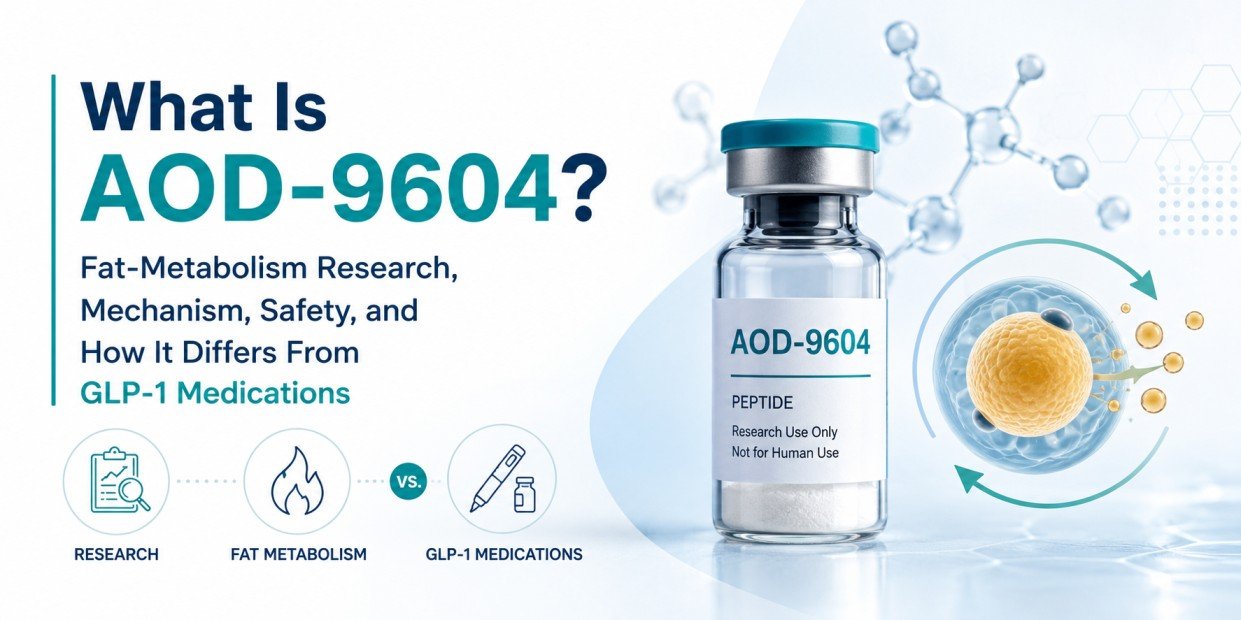
As interest in peptide research continues to grow, AOD-9604 has become one of the most frequently discussed compounds in conversations about body composition and fat metabolism. Researchers and health enthusiasts often compare it with GLP-1 medications such as Semaglutide and Tirzepatide because all three are associated with weight-management research. However, these compounds work through entirely different biological mechanisms and should not be considered interchangeable.
Unlike GLP-1 receptor agonists, which primarily influence appetite regulation and glucose metabolism, AOD-9604 is a synthetic peptide derived from a specific fragment of human growth hormone (HGH). It has been investigated for its potential role in fat-metabolism pathways while aiming to avoid many of the broader biological effects associated with full-length growth hormone.
Because of this unique mechanism, AOD-9604 has generated interest among researchers studying body composition, lipid metabolism, and metabolic health. At the same time, it is important to understand that current evidence remains limited, and much of the available research continues to explore its safety, mechanism, and potential applications.
In this guide, you’ll learn:
- What AOD-9604 is
- How it works
- How it differs from human growth hormone
- How it compares with Semaglutide and Tirzepatide
- What current research suggests
- Safety considerations
- How AOD-9604 fits into broader peptide research
If you’re new to peptide science, you may also find our guide on What Is Ipamorelin Peptide? Benefits, Fat Loss Potential, and How It Works helpful, as it explains another widely researched peptide with a completely different mechanism of action.
Quick Answer: What Is AOD-9604?
AOD-9604 is a synthetic peptide developed from amino acids 176–191 of human growth hormone (HGH). Rather than acting like the full growth hormone molecule, it has been studied for its potential involvement in fat-metabolism pathways.
Researchers have explored AOD-9604 to better understand how this specific HGH fragment may influence lipid metabolism without producing many of the broader physiological effects associated with complete growth hormone.
Unlike GLP-1 medications such as Semaglutide and Tirzepatide, AOD-9604 is not designed to regulate appetite, increase insulin secretion, or slow gastric emptying. Instead, its research has focused on different metabolic pathways that may influence how the body stores and utilizes fat.
Although early findings have generated scientific interest, AOD-9604 remains an active area of research, and additional high-quality studies are needed to fully understand its long-term effects and potential applications.
What Is AOD-9604?
AOD-9604 is a laboratory-developed peptide consisting of a small portion of the human growth hormone molecule known as Fragment 176–191. Scientists became interested in this region because earlier laboratory studies suggested it might be linked to metabolic processes involving fat tissue while being separate from many of the growth-promoting actions of the complete hormone.
Human growth hormone is a complex protein responsible for numerous physiological functions, including growth, tissue repair, and metabolic regulation. Because HGH affects many systems simultaneously, researchers explored whether isolating one specific fragment could provide a better understanding of individual biological pathways.
This work eventually led to the development of AOD-9604.
Instead of functioning as a replacement for growth hormone, AOD-9604 has been investigated as a distinct peptide with its own characteristics and research objectives.
Today, AOD-9604 is commonly discussed in studies involving:
- Fat metabolism
- Body composition
- Lipid metabolism
- Metabolic health
- Exercise-related research
However, it is important to recognize that these areas remain under scientific investigation, and findings should not be interpreted as established therapeutic outcomes.
For readers interested in how other peptides influence body composition through different biological pathways, our article on Can You Combine GLP-1 with Ipamorelin? Practical Guidance on Safety, Interactions, and Outcomes explores another area of ongoing peptide research.
One of the reasons AOD-9604 receives so much attention is that its proposed mechanism differs significantly from both growth hormone and GLP-1 medications.
Researchers believe the peptide may interact with metabolic pathways involved in the regulation of fat tissue rather than broadly affecting growth hormone activity throughout the body.
Laboratory research has primarily explored whether AOD-9604 may:
- Support lipolysis-related pathways (the breakdown of stored fat)
- Influence lipogenesis-related processes (the formation of new fat)
- Affect metabolic activity within adipose tissue
- Contribute to body-composition research
Unlike Semaglutide or Tirzepatide, these proposed mechanisms do not rely on appetite suppression or blood sugar regulation.
Instead, scientists have investigated whether AOD-9604 may directly influence how fat tissue behaves at the cellular level.
Although these mechanisms remain under investigation, they represent one of the primary reasons AOD-9604 continues to attract research interest within the peptide community.
Does AOD-9604 Work Like Human Growth Hormone?
This is one of the most common misconceptions surrounding the peptide.
Although AOD-9604 originates from a fragment of human growth hormone, it should not be considered the same as HGH.
Full-length growth hormone influences a wide range of biological systems, including:
- Growth and development
- Protein synthesis
- Bone metabolism
- Muscle development
- Recovery
- Cellular repair
- Hormonal signaling
AOD-9604, by comparison, was specifically developed to investigate whether one small portion of the hormone could be studied independently, particularly in relation to fat metabolism.
Because it represents only a tiny segment of the original HGH molecule, researchers generally evaluate it separately rather than treating it as a replacement for growth hormone therapy.
This distinction is important when comparing AOD-9604 with other peptides. For example, What Is Ipamorelin Peptide? Benefits, Fat Loss Potential, and How It Works explains how Ipamorelin works by stimulating the body’s own growth hormone release through a different biological pathway, making the two compounds fundamentally different despite often being discussed together.
AOD-9604 vs GLP-1 Medications: What’s the Difference?
One of the most common questions researchers and readers ask is whether AOD-9604 works like Semaglutide or Tirzepatide.
The short answer is no.
Although these compounds are frequently discussed together because of their association with body composition and weight-management research, they target entirely different biological pathways.
GLP-1 medications are designed to mimic incretin hormones that help regulate appetite, insulin secretion, and blood glucose levels. AOD-9604, on the other hand, is a synthetic fragment of human growth hormone that has primarily been studied for its potential role in fat-metabolism pathways.
Understanding these differences can help clarify why they are often compared but should not be viewed as direct alternatives.
| Feature | AOD-9604 | Semaglutide | Tirzepatide |
|---|---|---|---|
| Compound Type | HGH Fragment 176–191 | GLP-1 Receptor Agonist | Dual GIP/GLP-1 Receptor Agonist |
| Primary Research Focus | Fat metabolism | Appetite regulation and glucose metabolism | Appetite regulation and metabolic pathways |
| Appetite Suppression | Not considered its primary mechanism | Yes | Yes |
| Blood Sugar Regulation | Not its primary research focus | Yes | Yes |
| Growth Hormone Related | Derived from HGH fragment | No | No |
| Biological Pathway | Distinct metabolic pathway | GLP-1 pathway | GLP-1 and GIP pathways |
The comparison shows that while all three compounds are discussed within the broader field of metabolic research, their mechanisms and areas of investigation differ significantly.
If you are looking for a broader introduction to incretin-based therapies, our article GLP-1 Medications Explained provides an easy-to-understand overview of how this class of medications works and why it has become so important in metabolic research.
AOD-9604 vs Semaglutide
AOD-9604 and Semaglutide are often mentioned together because both appear in discussions about body composition. However, they approach metabolism from very different directions.
Semaglutide belongs to the GLP-1 receptor agonist class. It has been extensively studied for its effects on appetite regulation, gastric emptying, insulin secretion, and blood sugar control. Many of its observed effects on body weight are thought to result from reduced calorie intake due to increased feelings of fullness.
AOD-9604 is fundamentally different.
Rather than acting on GLP-1 receptors, it has been investigated for its potential influence on fat-metabolism pathways associated with a specific fragment of human growth hormone.
Key Differences
Semaglutide research commonly focuses on:
- Appetite regulation
- Caloric intake
- Blood glucose management
- Metabolic disease
AOD-9604 research commonly focuses on:
- Lipid metabolism
- Fat-cell activity
- Body-composition research
- Human growth hormone fragment biology
These differences highlight why one compound should not automatically be substituted for the other in research discussions.
If you are comparing different peptide-based approaches to body composition, you may also find our guide Ipamorelin vs Semaglutide: Key Differences in Fat Loss and Body Composition useful, as it explains another peptide that works through an entirely different biological mechanism.
AOD-9604 vs Tirzepatide
Tirzepatide has attracted considerable attention because it activates both the GLP-1 and GIP receptors, creating a dual-pathway approach that differs from traditional GLP-1 medications.
This mechanism has made Tirzepatide one of the most widely discussed compounds in metabolic research.
AOD-9604 follows an entirely separate research pathway.
Instead of targeting incretin receptors, investigators have explored whether AOD-9604 may interact with biological processes involved in fat metabolism through its relationship with the HGH fragment 176–191.
Comparison at a Glance
| Research Area | AOD-9604 | Tirzepatide |
| Appetite | Not primary focus | Major research focus |
| Gastric Emptying | Not primary mechanism | Studied extensively |
| Fat Metabolism | Primary research interest | Indirectly influenced through reduced calorie intake and metabolic changes |
| Growth Hormone Fragment | Yes | No |
Although both compounds appear in conversations surrounding body composition, the underlying science is very different.
For a deeper understanding of incretin therapies, you may also want to read Difference Between Semaglutide and Tirzepatide, along with our comprehensive guide GLP-1 Medications Explained.
What Does Current Research Say About AOD-9604?
AOD-9604 has been evaluated in laboratory and clinical research for several years, primarily in relation to body composition and fat metabolism.
Early studies generated interest because researchers observed that the peptide fragment might influence metabolic pathways differently from full-length human growth hormone.
However, it is important to interpret these findings carefully.
While some published studies have explored potential effects on fat metabolism, the available evidence remains limited, and results have not been entirely consistent across different research settings.
Current scientific literature continues to investigate questions such as:
- How AOD-9604 interacts with fat tissue
- Whether its biological activity differs significantly from HGH
- Which molecular pathways are involved
- Long-term safety considerations
- Potential future research applications
As with many emerging peptides, additional high-quality studies are necessary before broader conclusions can be drawn.
Research is an evolving process, and scientific understanding continues to develop over time.
Safety Considerations
Anyone researching AOD-9604 should recognize that scientific investigation is still ongoing.
While the peptide has been examined in various research settings, this does not mean every proposed benefit has been conclusively established.
When reviewing information online, readers should be cautious of articles that present definitive claims without referencing the current state of scientific evidence.
Instead, it is more accurate to understand AOD-9604 as a peptide that continues to be studied for its potential role in fat-metabolism research.
Key considerations include:
- Scientific evidence continues to evolve.
- Individual studies may produce different findings.
- More long-term research is needed.
- Conclusions should be based on the totality of available evidence rather than isolated reports.
Maintaining an evidence-based perspective helps distinguish educational resources from marketing claims.
How Does AOD-9604 Fit Into Body-Composition Research?
Body composition is influenced by far more than a single compound.
Researchers generally recognize that factors such as:
- Nutrition
- Physical activity
- Sleep quality
- Recovery
- Genetics
- Overall metabolic health
all contribute to body-composition outcomes.
For this reason, AOD-9604 is often discussed within a broader research framework rather than as an isolated solution.
Similarly, many researchers compare multiple peptide pathways when studying metabolic health.
If you would like to explore another frequently discussed topic, our article Can You Combine GLP-1 with Ipamorelin? examines how researchers compare these different peptide pathways and the questions that are still being investigated.
Understanding how different peptides are studied helps build a more complete picture of current metabolic research.
Learn More About AOD-9604 Research
If you would like to explore this peptide in more detail, visit our AOD-9604 10mg product page, where you will find product specifications, storage guidance, and additional educational information designed to support peptide research.
Related Peptides Often Compared With AOD-9604
AOD-9604 is often discussed alongside other research peptides because many compounds are studied in relation to body composition, recovery, metabolic health, or performance-focused research. However, each peptide has its own mechanism and should be understood separately.
Comparing AOD-9604 with other peptides can help readers understand where it fits within the broader peptide research landscape.
AOD-9604 and Ipamorelin
AOD-9604 and Ipamorelin are both commonly discussed in body-composition research, but they work through very different biological pathways.
AOD-9604 is derived from the 176–191 fragment of human growth hormone and has been studied for its potential role in fat-metabolism pathways. Ipamorelin, on the other hand, is a growth hormone secretagogue, meaning it is studied for its ability to stimulate the body’s natural growth hormone release.
Because both are sometimes discussed in relation to body composition, recovery, and lean mass support, people may assume they work the same way. They do not.
AOD-9604 research is more directly associated with fat-metabolism pathways, while Ipamorelin research is more closely connected with growth hormone signaling and recovery-related processes.
For a deeper explanation of Ipamorelin, read What Is Ipamorelin Peptide? Benefits, Fat Loss Potential, and How It Works.
You may also find Best Time to Take Ipamorelin helpful if you are exploring how timing is discussed in peptide research routines.
AOD-9604 and CJC-1295
CJC-1295 is another peptide commonly discussed in growth hormone-related research. Unlike AOD-9604, which is derived from a fragment of human growth hormone, CJC-1295 is studied for its relationship with growth hormone-releasing hormone pathways.
This means CJC-1295 is usually discussed in relation to growth hormone release, while AOD-9604 is more commonly discussed in relation to fat-metabolism research.
In peptide education, it is important to separate these mechanisms clearly.
AOD-9604 is not the same as CJC-1295, and CJC-1295 is not the same as Ipamorelin. Each compound has a different structure, research purpose, and biological pathway.
If you want to understand how growth hormone-related peptides are sometimes discussed together, our guide on CJC-1295 and Ipamorelin Stack provides useful background.
AOD-9604 and TB-500
TB-500 is usually discussed in a different category from AOD-9604.
While AOD-9604 is mainly associated with fat-metabolism research, TB-500 is commonly studied in relation to recovery, tissue support, mobility, and repair-related pathways.
That distinction matters because not every peptide discussed in body-composition or wellness communities has the same purpose.
AOD-9604 is more relevant to metabolic research, while TB-500 is more relevant to recovery-focused research.
If you are building internal topical authority around peptides, connecting these articles helps Google understand that Core Trust Lab covers multiple research peptide categories in a structured way.
For more context, read TB-500 Peptide: Benefits for Recovery, Fat Loss Support, and How It Fits with GLP-1 Therapy.
You may also find TB-500 vs BPC-157: Comparative Benefits, Uses, and Safety Considerations useful if you are comparing recovery-focused peptides.
Who Is AOD-9604 Research Most Relevant For?
AOD-9604 is most relevant for readers and researchers interested in understanding how specific peptide fragments may be studied in relation to fat metabolism and body composition.
It may be especially relevant in educational discussions involving:
- Fat-metabolism pathways
- HGH fragment research
- Lipid metabolism
- Body-composition studies
- Peptide mechanism comparisons
- GLP-1 vs non-GLP-1 metabolic research
However, AOD-9604 should not be presented as a guaranteed solution for weight loss, fat loss, or metabolic improvement. The available research is still developing, and conclusions should be made carefully.
This is why it is important to compare AOD-9604 with GLP-1 medications in a precise way. Semaglutide and Tirzepatide are incretin-based compounds that influence appetite and glucose-related pathways, while AOD-9604 is studied through a different research lens.
For readers who want to understand GLP-1 pathways more clearly, GLP-1 Medications Explained is a useful starting point.
Common Misconceptions About AOD-9604
Because AOD-9604 is often discussed online in simplified or promotional language, several misconceptions are common.
Misconception 1: AOD-9604 Is the Same as Growth Hormone
This is not accurate.
AOD-9604 is derived from a small fragment of human growth hormone, but it is not the same as full-length growth hormone. HGH affects many biological systems, while AOD-9604 is studied more narrowly in relation to specific metabolic pathways.
Misconception 2: AOD-9604 Works Like Semaglutide
AOD-9604 and Semaglutide are completely different compounds.
Semaglutide is a GLP-1 receptor agonist. AOD-9604 is an HGH fragment peptide. Their mechanisms, research applications, and biological targets are different.
For a broader comparison of GLP-1-related body-composition topics, read Ipamorelin vs Semaglutide: Key Differences in Fat Loss and Body Composition.
Misconception 3: AOD-9604 Mainly Works by Suppressing Appetite
AOD-9604 is not primarily discussed as an appetite-regulating compound.
Unlike GLP-1 medications, its research focus is not centered on slowing gastric emptying or reducing food intake. Its primary research association is with fat-metabolism pathways.
Misconception 4: More Research Means Proven Results
Research interest does not automatically mean a compound has fully established outcomes.
AOD-9604 remains an area of ongoing study. Claims should be reviewed carefully, especially if they sound absolute or overly promotional.
Frequently Asked Questions About AOD-9604
What is AOD-9604?
AOD-9604 is a synthetic peptide derived from amino acids 176–191 of human growth hormone. It has been studied for its potential role in fat-metabolism and body-composition research.
Is AOD-9604 the same as HGH?
No. AOD-9604 is not the same as full-length human growth hormone. It is a specific HGH fragment studied for more targeted metabolic research purposes.
How is AOD-9604 different from Semaglutide?
AOD-9604 is an HGH fragment peptide, while Semaglutide is a GLP-1 receptor agonist. Semaglutide is studied for appetite regulation, gastric emptying, and glucose metabolism, while AOD-9604 is studied mainly for fat-metabolism pathways.
How is AOD-9604 different from Tirzepatide?
Tirzepatide works through dual GIP and GLP-1 receptor pathways. AOD-9604 does not target those receptors. It is studied through a different mechanism related to HGH fragment research.
Does AOD-9604 suppress appetite?
AOD-9604 is not primarily studied as an appetite suppressant. Its research focus is generally associated with fat metabolism rather than appetite regulation.
Is AOD-9604 approved as a weight-loss medication?
AOD-9604 should not be described as an approved weight-loss medication without verifying the applicable regulatory context. It is more accurate to discuss it as a research peptide studied for fat-metabolism-related pathways.
Can AOD-9604 be compared with GLP-1 medications?
Yes, but only carefully. AOD-9604 and GLP-1 medications are often compared because both appear in body-composition discussions, but their mechanisms are very different.
Can AOD-9604 be combined with GLP-1 medications?
Combination discussions should be approached cautiously and should not be simplified. If you want to understand how GLP-1 medications are discussed alongside other peptides, read Can You Combine GLP-1 with Ipamorelin? Practical Guidance on Safety, Interactions, and Outcomes.
Where can I learn more about AOD-9604?
You can learn more by reviewing scientific literature and visiting the AOD-9604 10mg research peptide page for product-specific educational details.
Final Thoughts: What Makes AOD-9604 Different?
AOD-9604 is best understood as a research peptide derived from the 176–191 fragment of human growth hormone. Its main area of interest is fat-metabolism research, not appetite suppression or GLP-1 receptor activation.
This makes it very different from Semaglutide and Tirzepatide.
GLP-1 medications are primarily associated with appetite regulation, gastric emptying, blood glucose control, and incretin signaling. AOD-9604 is studied through a separate pathway connected to HGH fragment biology and lipid metabolism.
That difference is important for both readers and researchers.
Rather than treating AOD-9604 as a direct alternative to GLP-1 medications, it is more accurate to view it as a separate research compound within the broader field of metabolic and body-composition science.
Current research remains ongoing, and careful interpretation is necessary. Strong peptide education should avoid exaggerated claims and focus instead on mechanism, evidence, limitations, and safety considerations.
For readers who want to continue learning, Core Trust Lab offers additional educational resources covering GLP-1 medications, Ipamorelin, TB-500, CJC-1295, and other research peptides. You can also explore the AOD-9604 10mg product page for more product-specific information.