$190.00Original price was: $190.00.$112.00Current price is: $112.00.
5-Aminolevulinic Acid (ALA) is a naturally occurring compound and a precursor in the heme biosynthesis pathway. When applied to the skin, ALA is absorbed by rapidly dividing or abnormal cells and converted to protoporphyrin IX (PpIX) — a light-sensitive molecule.
Upon exposure to specific wavelengths of light, PpIX becomes photoactivated, releasing reactive oxygen species (ROS) that selectively destroy targeted skin cells. This makes ALA a valuable agent in non-invasive skin therapies like:
Actinic keratoses (AKs)
Inflammatory acne
Sun damage and photorejuvenation
Sebaceous hyperplasia and skin texture improvement
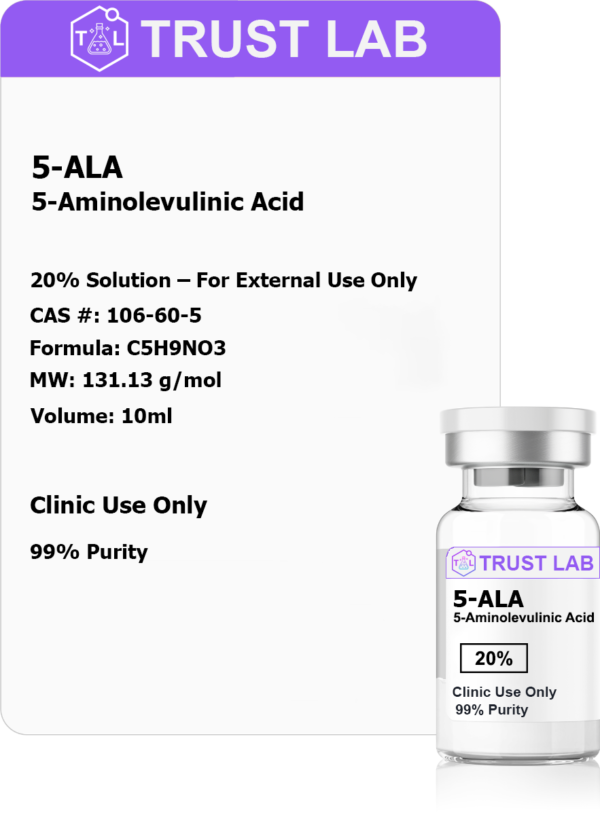
5-Aminolevulinic Acid (ALA) 20% is applied topically under practitioner supervision as part of a controlled photodynamic therapy (PDT) protocol. It is not for injection.
A thin, even layer is applied to the treatment area (typically 1–3 ml depending on the surface area), followed by an occlusion period of 1–4 hours. After incubation, the treated area is exposed to a specific light wavelength, usually red light (635 nm) or blue light (415 nm), to activate the photosensitizer.
Typical protocol:
Apply topically, avoiding eyes and mucous membranes
Incubate for 1–4 hours as directed
Activate with PDT light source
Repeat every 2–4 weeks for 1–4 sessions depending on condition
Avoid direct sun or bright indoor light for 48 hours post-treatment
Use only as directed by a medical or licensed skincare professional.
5-Aminolevulinic Acid (ALA) is a naturally occurring compound and a precursor in the heme biosynthesis pathway. When applied to the skin, ALA is absorbed by rapidly dividing or abnormal cells and converted to protoporphyrin IX (PpIX) — a light-sensitive molecule.
Upon exposure to specific wavelengths of light, PpIX becomes photoactivated, releasing reactive oxygen species (ROS) that selectively destroy targeted skin cells. This makes ALA a valuable agent in non-invasive skin therapies like:
Actinic keratoses (AKs)
Inflammatory acne
Sun damage and photorejuvenation
Sebaceous hyperplasia and skin texture improvement
After absorption, ALA is metabolized into protoporphyrin IX (PpIX) within the target cells. PpIX is then photoactivated using red or blue light, generating singlet oxygen and ROS, which induce selective cytotoxicity in abnormal cells without harming surrounding tissue.
Accumulates in dysplastic or hyperproliferative cells
Generates oxidative stress upon light activation
Triggers controlled cell death (apoptosis)
Enhances collagen remodeling and skin tone post-treatment
There are no controlled human studies evaluating topical ALA in pregnancy or lactation. It should be avoided in pregnant or breastfeeding individuals unless deemed medically necessary and used under physician supervision.
Not recommended for pediatric use unless under the direction of a qualified dermatologist. Pediatric applications are investigational and require caution.
Topical 5-Aminolevulinic Acid (ALA) is FDA-approved in specific concentrations and formats (e.g., Levulan® Kerastick) for the treatment of actinic keratoses.
However, compounded 20% ALA solutions are not FDA-approved for general use and are considered investigational. Use is restricted to medical and cosmetic professionals.